Skip to content
Kitchener Prestige Flooring

Tile & stone

Ceramic and Porcelain Tile Installation in Kitchener

Ceramic and porcelain are the most common floor tiles in Waterloo Region homes, and they are not interchangeable. Kitchener Prestige Flooring helps homeowners, renovators and builders choose the right tile for each room, then installs it flat and tight.

In more than 16 years and 1,700+ flooring jobs, we have set everything from 2 inch mosaics to 48 inch porcelain slabs. We know which tiles chip, which ones slip when wet and which ones need special mortar.

Our tile team is licensed, insured and WSIB covered. Every installation includes a written 1-year labour warranty and a detailed written quote.
  • Licensed & insured
  • WSIB covered
  • 1-year labour warranty
  • Free in-home estimates
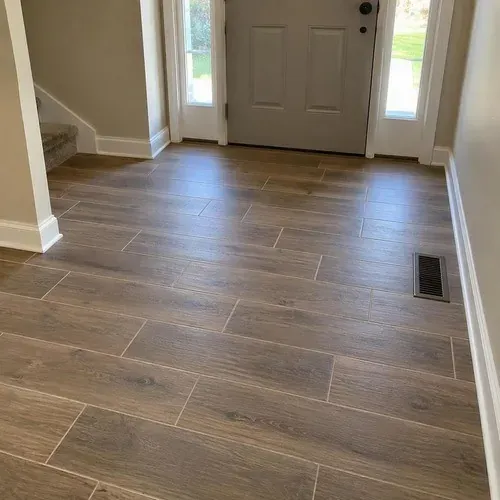
Wood-look porcelain plank tile installed in a Kitchener entryway

Ceramic Versus Porcelain, the Difference That Matters

Both are made from fired clay. Porcelain uses finer clay and higher kiln temperatures, which makes it denser and harder.

Installation methods and membranes are covered on our main tile flooring installation page. This page is about choosing the material.

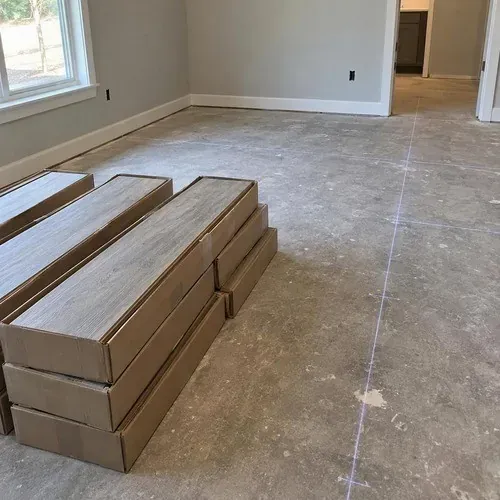
Boxes of wood-look porcelain tile planks beside layout lines

Water Absorption Rates

Porcelain must absorb 0.5% of its weight in water or less. Ceramic usually absorbs 3 to 7%.

That makes porcelain the better choice for basements, entries that see meltwater and road salt, and anywhere near freeze-thaw exposure, like an unheated porch.

Through-Body Versus Glazed Porcelain

Glazed porcelain has a printed, glazed surface over a plain body. If it chips, the lighter body shows through.

Through-body or colour-body porcelain carries the colour through the whole tile. Chips are much harder to see, which is why we recommend it for commercial floors and busy kitchens.

PEI Ratings and Choosing for the Right Room

The PEI rating measures how well a glazed surface resists wear. It is printed on most tile boxes.

PEI rating Suitable for
PEI 1 Walls only
PEI 2 Bathrooms and bedrooms with light, barefoot traffic
PEI 3 Most residential floors, including kitchens and halls
PEI 4 Busy homes, entryways and light commercial
PEI 5 Heavy commercial, retail and public spaces

A beautiful PEI 2 tile in a mudroom will look worn within a couple of winters. We check ratings before you buy.

Slip Resistance and Wet Area Selection

Slip resistance is measured as DCOF, the dynamic coefficient of friction. For level interior floors that may get wet, look for a DCOF of 0.42 or higher.

Bathroom floors, entries and commercial kitchens need it most. Polished and high-gloss tiles often fall below that line, so we steer them to walls and dry rooms.

For businesses, slip resistance is also a liability question. We can supply the manufacturer's test data for your records.

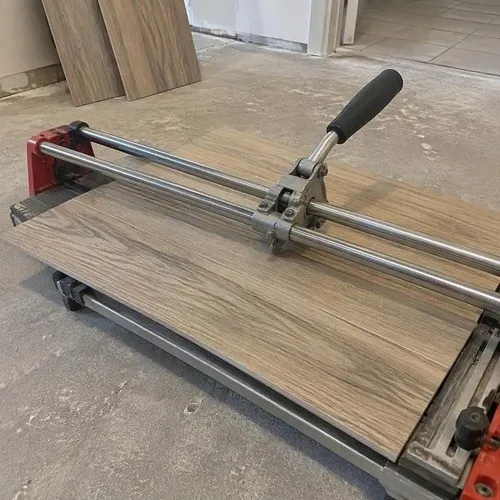
Porcelain tile being scored on a manual rail cutter

Porcelain Tile That Looks Like Wood or Stone

Wood-look porcelain planks are one of the most requested floors we install. They give a wood look in basements, bathrooms and heated floors where real wood would struggle.

Plank tiles have their own layout rules. Offsets are kept to one third of the length, grout lines are tight and matched to the plank colour, and boards are mixed from several boxes so the pattern does not repeat.

Stone-look porcelain copies marble, slate and limestone without the sealing and maintenance. Compare it with real slate flooring if you are torn.

Thinset Selection and Large Format Requirements

Standard tiles set well in an improved polymer-modified thinset. Large format tiles need a medium-bed or large-and-heavy-tile mortar that will not slump under their weight.

We back-butter large tiles with a thin layer of mortar, set them with a slight sliding motion and pull test tiles to check coverage. Dry areas need at least 80% coverage and wet areas 95%.

Glass, some translucent porcelains and very dense tiles need specific mortars. We match the thinset to the tile maker's instructions.

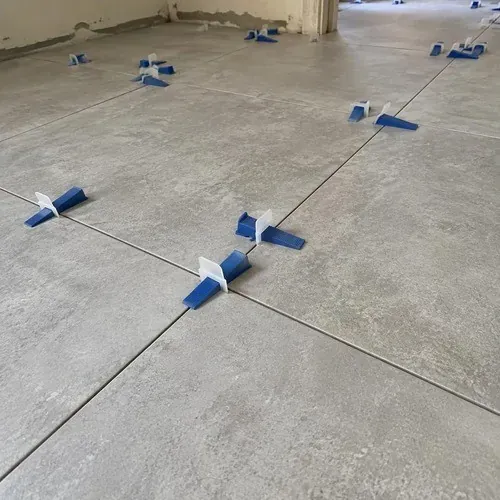
Levelling clips between large porcelain tiles to prevent lippage

Cutting, Drilling and Edge Finishing

Clean cuts make a floor look professional. We use wet saws for porcelain, rail cutters for straight scoring and diamond core bits for pipe and drain holes.

Wet cutting happens outside or in a contained area so dust does not spread through your home.

Mitred Edges and Metal Trims

Where tile ends at a step, wall or change in floor, the edge needs a finish. Porcelain's plain body usually looks poor if left exposed.

We mitre edges at 45 degrees for a seamless corner or use metal profiles, such as Schluter trims in aluminium or stainless steel. Both protect the edge from chipping.

Grout Selection, Cement Versus Epoxy

Cement grout is affordable and easy to work. It needs sealing and can stain in kitchens.

High-performance cement grouts add polymers for better colour consistency and stain resistance. They suit most homes.

Epoxy grout is stain proof, never needs sealing and resists chemicals. It is ideal for kitchens, showers and restaurants. For tired existing grout, our tile and grout restoration service can clean and recolour it.

Ceramic and Porcelain Pricing

Typical 2026 installation labour in Kitchener and Waterloo, before material:

Tile type Labour per sq ft
Ceramic, 12 to 18 inch $6.00 to $9.00
Porcelain, 12 by 24 inch $7.00 to $11.00
Wood-look porcelain plank $8.00 to $12.00
Large format, 24 by 48 and up $9.00 to $15.00

Heated floors can go under any of these. See radiant heated flooring installation. All tile work includes our 1-year labour warranty.

FAQ

Ceramic and Porcelain Questions

Straight answers to the questions we hear most. Still unsure? Call and ask.

Ask for a Free Quote

Is porcelain always better than ceramic?

Not always. Porcelain is denser, absorbs less water and resists chipping, so it is better for entries, basements and busy kitchens. Ceramic is easier to cut, often costs less and works perfectly well on bathroom floors and low-traffic rooms.

What PEI rating do I need for a busy kitchen?

Choose PEI 3 or higher for a kitchen. PEI 4 is a safer choice if you have pets, kids or a door to the backyard, since grit from outside wears glazes quickly.

Should I use epoxy grout?

Epoxy grout is stain proof and never needs sealing, which makes it ideal for kitchens, showers and commercial spaces. It costs more and is harder to install. For most floors, a high-performance cement grout is a good middle ground.

Does wood-look porcelain need a special layout?

Yes. Long plank tiles can bow slightly, so we limit the offset to about one third of the plank length and use levelling clips. A random offset of 50% causes uneven edges on most plank tiles.

Free estimate

Book a Free Ceramic & Porcelain Tile Installation Estimate

Tell us about the floor. We will call to book a time, measure on site, check the subfloor and moisture, and leave you a written quote.

Prefer to talk it through first? Call and speak to a flooring specialist directly.

  • Measured on site, with moisture and flatness readings
  • Written, itemized quote with no obligation
  • Licensed, insured, WSIB covered, 1-year labour warranty

Kitchener Prestige Flooring

137 Glasgow St, Kitchener, ON N2M 5E3

info@kitchenerflooring.ca

Monday to Saturday: 7:00am to 9:30pm

Sunday: 9:00am to 9:00pm

Call (548) 490-1518 Quote