Skip to content
Kitchener Prestige Flooring

Concrete & epoxy

Epoxy Flooring Installation in Kitchener, Ontario

Epoxy floors fail for one reason more than any other: poor surface preparation. Kitchener Prestige Flooring installs epoxy, polyaspartic and urethane cement floors for homeowners, shops, warehouses and food businesses across Kitchener and Waterloo Region, and prep is where every job starts.

With more than 16 years and 1,700 flooring jobs behind us, we have scraped off plenty of peeling DIY kits and roller-and-bucket coatings. We diamond grind or shot blast every slab, test for moisture and repair cracks before any resin goes down.

Our crew is licensed, insured and WSIB covered, with documentation for commercial and industrial sites. Every coating includes a written 1-year labour warranty.
  • Licensed & insured
  • WSIB covered
  • 1-year labour warranty
  • Free in-home estimates
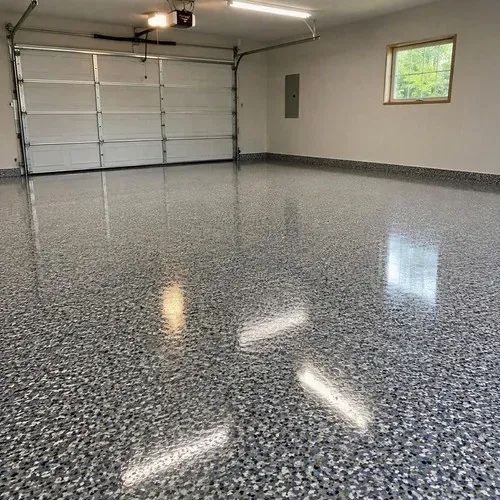
Glossy flake epoxy garage floor finished in a Kitchener home

Where Resin Floors Belong

Resin floors are seamless, easy to clean and resistant to oil, salt and chemicals. The right system depends on what the floor will face.

Residential Garages and Workshops

In Waterloo Region, garage floors take a beating from road salt and meltwater all winter. Bare concrete pits and flakes within a few years.

A flake epoxy or polyaspartic system seals the slab, cleans with a squeegee and looks sharp. Home workshops get the same system with a slip-resistant topcoat.

Warehouses and Manufacturing Floors

Warehouses and plants need floors that handle forklifts, pallet jacks and dropped parts. We install high-build epoxy in solid colours with line striping and safety markings.

Cambridge and Kitchener's industrial areas are full of slabs that need this work. Our industrial flooring service covers the full scope.

Food Production and Commercial Kitchens

Food plants and restaurant kitchens face hot water, grease, cleaning chemicals and thermal shock. Standard epoxy cracks under those conditions.

Urethane cement is built for it. It tolerates steam cleaning and temperature swings and can be finished with a textured, sanitary surface and integral cove base.

Epoxy, Polyaspartic and Urethane Cement Compared

These are the three resin systems we install. Each has a clear strength.

Epoxy Polyaspartic Urethane cement
Cure speed Slow, 12 to 24 hours between coats Fast, walkable in hours Moderate
Minimum temperature About 10 °C Near freezing About 5 °C
UV stability Can yellow in sunlight Excellent Good
Chemical and heat resistance Good Good Excellent
Best use Base coats, industrial floors Garage topcoats, fast return Food plants, kitchens

Many of our garage floors combine an epoxy base coat with a polyaspartic topcoat. You get epoxy's bond and build with polyaspartic's toughness and UV stability.

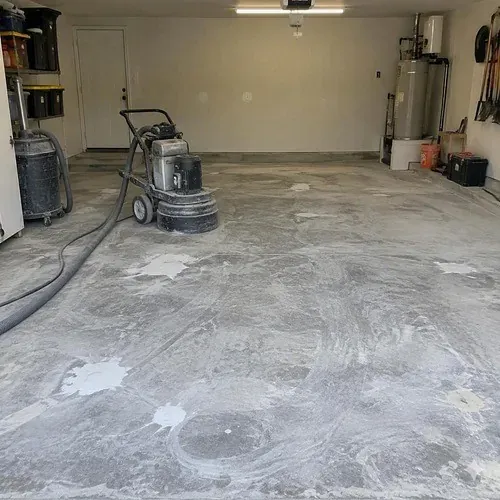
Garage slab diamond ground and patched before an epoxy floor coating

Surface Preparation, Where Most Coatings Fail

A coating is only as good as its bond to the concrete. This is where real contractors separate from roller-and-bucket operations.

Diamond Grinding and Shot Blasting

We grind slabs with planetary diamond grinders connected to HEPA dust extractors. That opens the surface to a profile the coating can grip, usually CSP 2 to 3.

Larger commercial floors are shot blasted, which fires steel shot at the surface for a deeper profile. We never rely on acid etching, which leaves residue and an uneven profile.

Moisture Vapour Testing and Mitigation

Moisture pushing up through a slab is the second biggest cause of peeling. Basement and slab-on-grade floors without a vapour barrier are the usual culprits.

We test with calcium chloride kits or in-situ humidity probes. High readings get a moisture vapour barrier primer before the coating system.

Crack and Joint Repair Before Coating

Cracks are routed out and filled with a semi-rigid polyurea or epoxy filler, then ground flush. Spalled areas and pits get a resin mortar patch.

Control joints in industrial floors are filled with a flexible polyurea so forklift wheels do not chip the edges.

Finish Options, Flake, Quartz and Solid Colour

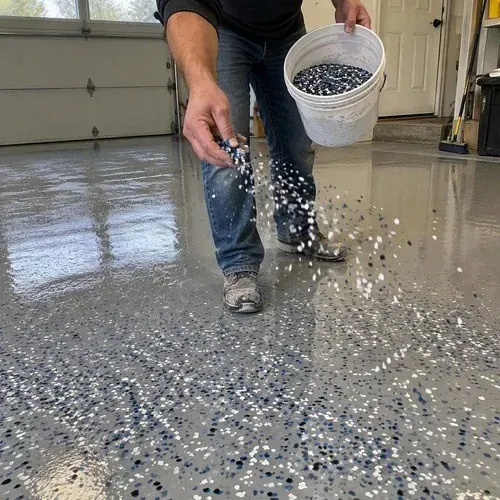
Full-broadcast flake is the most popular garage finish. Coloured vinyl flakes are broadcast into the wet base coat to rejection, then sealed. It hides dirt and adds texture.

Quartz broadcast uses coloured quartz sand for a very hard, textured surface. It suits commercial kitchens, washrooms and ramps.

Solid colour high-build epoxy is standard in warehouses and plants, often with painted aisles and markings.

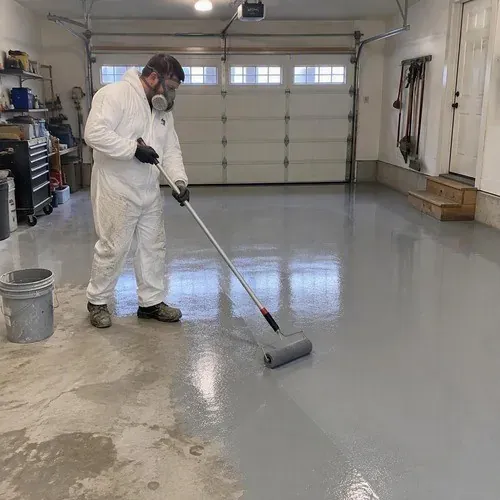
Grey epoxy base coat rolled onto a prepared concrete floor

Slip Resistance and Safety Additives

A smooth, glossy coating can be slippery when wet or oily. We mix aluminium oxide grit into the topcoat to add grip without making the floor hard to clean.

The amount of grit is adjusted by area. A garage needs light texture, while a food plant floor near a washdown drain needs far more.

Commercial floors can include line striping, safety yellow walkways and hazard markings as part of the system.

Cure Times and Return to Service

Downtime is the first question industrial clients ask. Here are typical figures at around 20 degrees Celsius.

  • Polyaspartic topcoat: walk in 4 to 6 hours, vehicles in 24 to 48 hours.
  • Full epoxy system: walk in 24 hours, vehicles in 5 to 7 days.
  • Urethane cement: light traffic in 8 to 24 hours, full service in 2 to 3 days.

Plants and warehouses can be coated in phases, overnight or over a long weekend so production keeps running.

Vinyl flakes broadcast by hand into a wet epoxy base coat

Epoxy Pricing Per Square Foot

Typical 2026 installed ranges in Kitchener and Waterloo, including prep:

System Installed cost per sq ft
Garage flake epoxy with polyaspartic topcoat $6.00 to $10.00
Solid colour industrial epoxy $4.00 to $8.00
Quartz broadcast system $8.00 to $12.00
Urethane cement, 1/4 inch $10.00 to $16.00

Every coating includes our 1-year labour warranty. Already have a tired epoxy floor? Our epoxy floor recoating service can bring it back.

Pouring a new slab first? See concrete floor installation.

Prefer no coating at all? Consider concrete polishing.

FAQ

Epoxy Flooring Questions

Straight answers to the questions we hear most. Still unsure? Call and ask.

Ask for a Free Quote

How long does an epoxy garage floor last?

A professionally installed flake system on a properly ground slab usually lasts 15 to 20 years in a home garage. The topcoat may need a refresh after 8 to 12 years if it sees heavy salt and tire traffic.

Can epoxy be applied in an unheated garage over winter?

Standard epoxy needs the slab at 10 degrees Celsius or warmer and rising. In colder months we use polyaspartic coatings, which cure at much lower temperatures, or temporarily heat the space.

Why do some epoxy floors peel after a year?

Almost always because the slab was not ground or blasted, only acid etched or cleaned. Moisture coming up through the slab and cheap water-based kits that soften under hot tires are the other common causes.

How soon can we drive on it?

With polyaspartic topcoats, you can usually walk on the floor in a few hours and drive on it in 24 to 48 hours. Full epoxy systems need about 5 to 7 days before vehicles, depending on temperature.

Free estimate

Book a Free Epoxy Flooring Installation Estimate

Tell us about the floor. We will call to book a time, measure on site, check the subfloor and moisture, and leave you a written quote.

Prefer to talk it through first? Call and speak to a flooring specialist directly.

  • Measured on site, with moisture and flatness readings
  • Written, itemized quote with no obligation
  • Licensed, insured, WSIB covered, 1-year labour warranty

Kitchener Prestige Flooring

137 Glasgow St, Kitchener, ON N2M 5E3

info@kitchenerflooring.ca

Monday to Saturday: 7:00am to 9:30pm

Sunday: 9:00am to 9:00pm

Call (548) 490-1518 Quote