Skip to content
Kitchener Prestige Flooring

Tile & stone

Terrazzo Flooring Installation in Kitchener, Ontario

Terrazzo is a seamless floor of marble, glass or stone chips set in a binder, ground flat and polished. Kitchener Prestige Flooring installs epoxy and cementitious terrazzo for schools, healthcare facilities, commercial lobbies and custom homes across Kitchener and Waterloo Region.

Our team has more than 16 years of experience and 1,700+ flooring jobs completed. Terrazzo draws on every part of that experience, from slab moisture testing to multi-stage diamond grinding.

We are licensed, insured and WSIB covered, with documentation ready for institutional and commercial projects. Our workmanship carries a written 1-year labour warranty.

  • Licensed & insured
  • WSIB covered
  • 1-year labour warranty
  • Free in-home estimates
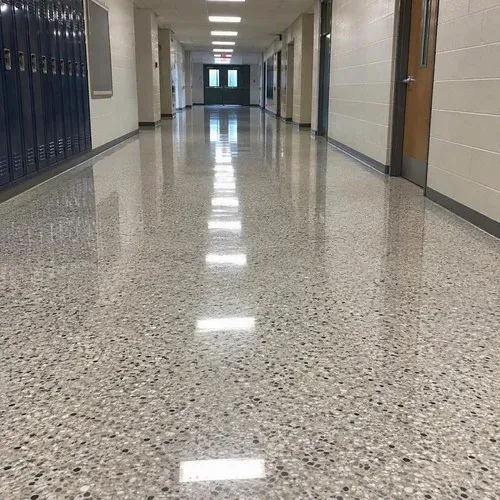
Polished terrazzo floor in a commercial corridor reflecting the ceiling lights

What Terrazzo Is and Why It Lasts Generations

Terrazzo started in 15th century Venice, where workers set marble scraps in clay and ground them smooth. Today it is poured on site with modern binders and precise grinding.

The result is a seamless, extremely hard surface with no grout lines to wear or stain. It resists heavy traffic, cleans easily and never needs replacing, only occasional polishing.

Terrazzo floors installed in Ontario schools and hospitals in the 1950s are still in service. That longevity is the whole argument for it.

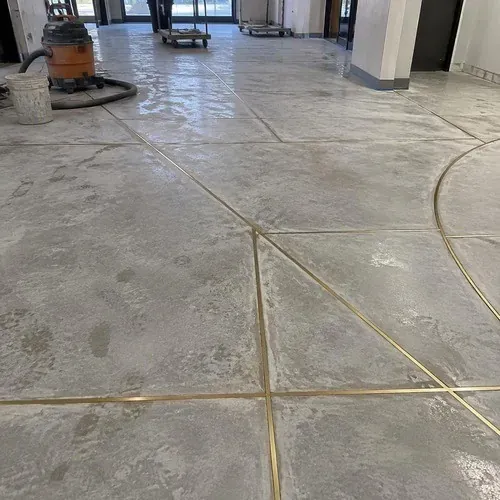
Brass terrazzo divider strips laid out on a prepared concrete slab

Epoxy Terrazzo Versus Cementitious Terrazzo

The binder is the core technical decision. It decides thickness, flexibility and where the floor can go.

Thin-Set Epoxy Systems for Interiors

Epoxy terrazzo is about 1/4 to 3/8 inch thick and very light. It cures quickly, comes in almost any colour and resists chemicals.

It is for interiors only, because UV light can yellow some epoxies over time. It needs a stable, well-prepared concrete slab and usually a crack isolation membrane.
Sand Cushion Cementitious for Movement Tolerance

Sand cushion terrazzo is a thick cement system, about 2-1/2 to 3 inches. A bed of sand and an isolation sheet separate it from the structural slab.

That separation lets the building move without cracking the terrazzo. It suits large buildings, exterior applications and slabs with a history of movement. Bonded cementitious systems are a thinner middle option.

Aggregate Selection and Custom Colour

Terrazzo is a design product. You choose the binder colour and the aggregate, and together they create a floor no one else has.

Common aggregates include marble chips in dozens of colours, recycled glass, mirror, mother of pearl and granite. Chip sizes range from fine to large for bold, Venetian-style floors.

We prepare sample boards before the pour so you can approve colour and mix. Logos, patterns and wayfinding designs can be built in. See our custom floor design and inlay work for ideas.

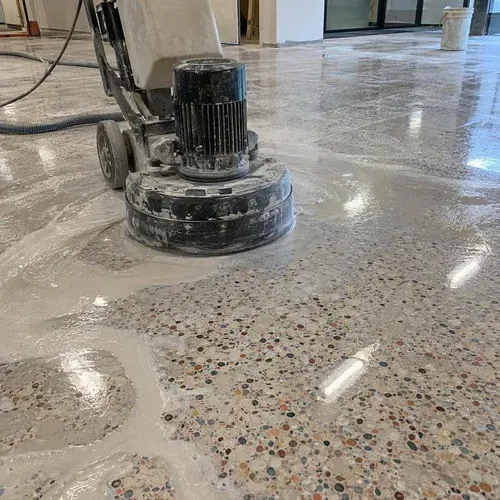
Floor grinder polishing cured terrazzo with slurry on the surface

Divider Strips, Control Joints and Layout

Terrazzo is poured in sections separated by metal divider strips, usually brass, zinc or aluminium. They are often seen as decoration, but their first job is structural.

Strips placed over the slab's control joints let the terrazzo move where the concrete moves, instead of cracking at random. They also separate colours in patterned designs.

We map every slab joint during layout, then plan the design so strips fall where they are needed and look intentional.

Substrate Preparation and Moisture Testing

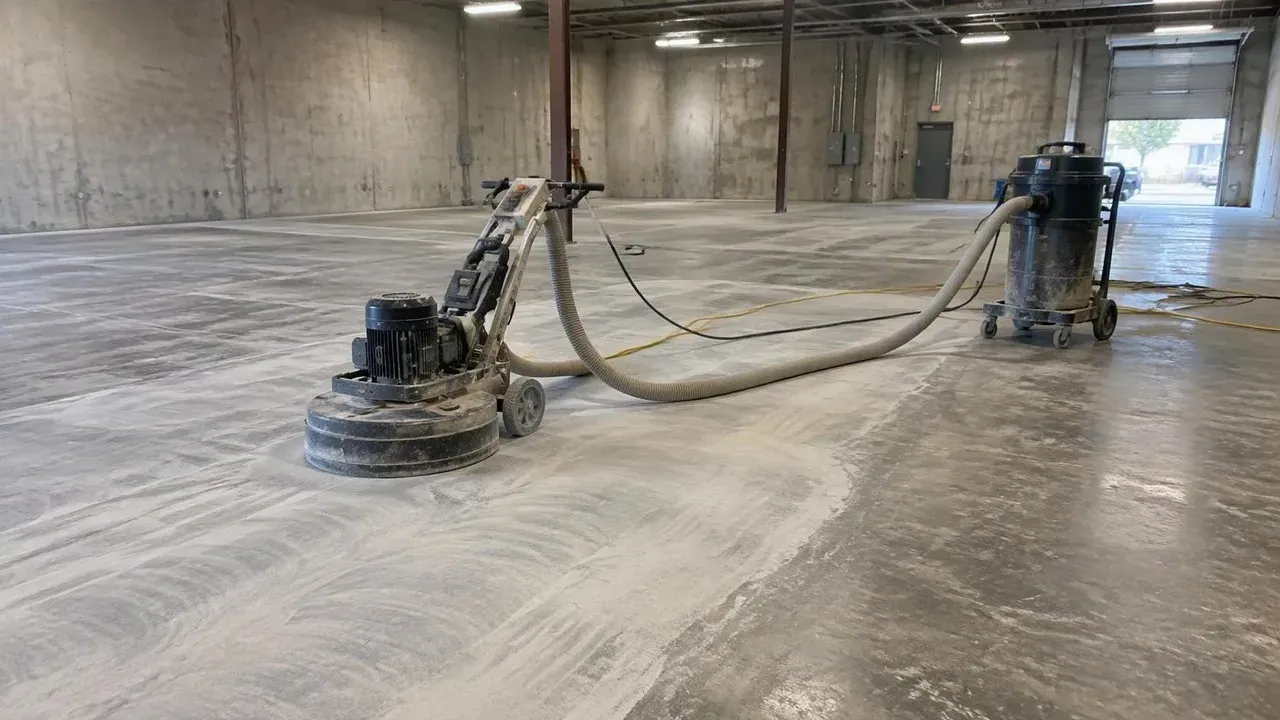
Terrazzo is only as sound as the slab beneath it. We shot blast or diamond grind the concrete to open the surface for bonding.

Moisture testing uses in-situ relative humidity probes placed in the slab. Readings above the binder maker's limit mean we apply a moisture mitigation primer first.

Cracks are routed and filled, and a crack isolation membrane is applied under epoxy systems.

Concrete slab being shot blasted and ground before terrazzo is poured

Grinding, Grouting and Polishing Stages

Once the terrazzo cures, the real finishing begins. It is a multi-stage process that takes days, not hours.

  1. Rough grind with coarse diamonds, around 24 to 60 grit, to expose the aggregate and flatten the surface.
  2. Grout the surface with a matching binder to fill pinholes and voids revealed by grinding.
  3. Fine grind through progressively finer diamonds, around 120 to 400 grit.
  4. Polish up to 800 to 3000 grit, depending on the sheen you want.
  5. Seal with a penetrating sealer and, for commercial floors, a maintenance finish.

Terrazzo in Institutional and Commercial Buildings

Terrazzo's natural buyers are schools, universities, hospitals, transit stations and airports. Waterloo Region's institutions and growing commercial core are full of examples.

These owners value a floor that lasts the life of the building and cleans with plain water and a scrubber. Low whole-life cost matters more than the price on day one.

We work with general contractors, architects and facility managers to phase work around occupied buildings. See our commercial flooring page for other systems we install alongside terrazzo.

Terrazzo Cost and Whole-Life Value

Typical 2026 installed ranges in Waterloo Region:

System Installed cost per sq ft
Thin-set epoxy terrazzo $25.00 to $50.00
Bonded cementitious terrazzo $30.00 to $55.00
Sand cushion cementitious terrazzo $40.00 to $70.00
Precast terrazzo tile $20.00 to $40.00

Terrazzo costs more than most floors up front. Spread over 75 years with no replacement, it is one of the cheapest to own. If budget is tighter, concrete polishing gives a similar seamless look for less.

FAQ

Terrazzo Questions

Straight answers to the questions we hear most. Still unsure? Call and ask.

Ask for a Free Quote

How long does a terrazzo floor installation take?

A mid-sized epoxy terrazzo floor usually takes three to six weeks from slab prep to final polish. Cementitious systems take longer because each layer needs time to cure. We give you a stage-by-stage schedule before work starts.

Is terrazzo more expensive than polished concrete?

Yes, usually three to five times more per square foot up front. Terrazzo adds the aggregate, binder, strips and extra grinding. Over its 75 year plus life, though, it is one of the lowest-cost floors to own.

Can terrazzo be installed in a house?

Yes. Thin-set epoxy terrazzo, about 3/8 inch thick, works in homes with a solid, stiff concrete base.

Kitchens, entries and basements are the most common rooms. Precast terrazzo tiles are another option over wood framing.

Does terrazzo crack?

Terrazzo can crack if the slab beneath it cracks. That is why we place divider strips over slab control joints and use crack isolation membranes. Cementitious sand cushion systems separate the terrazzo from the slab entirely.

Free estimate

Book a Free Terrazzo Flooring Installation Estimate

Tell us about the floor. We will call to book a time, measure on site, check the subfloor and moisture, and leave you a written quote.

Prefer to talk it through first? Call and speak to a flooring specialist directly.

  • Measured on site, with moisture and flatness readings
  • Written, itemized quote with no obligation
  • Licensed, insured, WSIB covered, 1-year labour warranty

Kitchener Prestige Flooring

137 Glasgow St, Kitchener, ON N2M 5E3

info@kitchenerflooring.ca

Monday to Saturday: 7:00am to 9:30pm

Sunday: 9:00am to 9:00pm

Call (548) 490-1518 Quote