Skip to content
Kitchener Prestige Flooring

Concrete & epoxy

Concrete Floor Installation in Kitchener, Ontario

A new concrete floor is the foundation for everything that goes on top of it, whether that is epoxy, polished concrete or hardwood. Kitchener Prestige Flooring places basement slabs, garage floors, shop floors and overlays for homeowners, builders and businesses across Kitchener and Waterloo Region.

Our crew has more than 16 years and 1,700+ jobs of flooring experience. We see the results of rushed concrete every week, which is why we care so much about the base, the joints and the cure.

We are licensed, insured and WSIB covered. Every concrete floor includes a written 1-year labour warranty and a clear plan for what comes next.

  • Licensed & insured
  • WSIB covered
  • 1-year labour warranty
  • Free in-home estimates
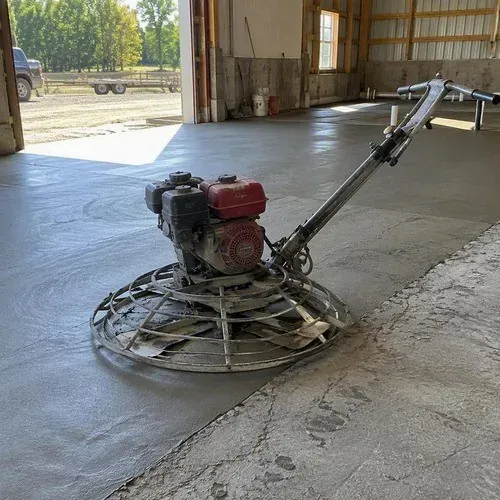
Power trowel finishing a new concrete floor slab

Where a New Concrete Floor Is the Right Answer

Sometimes the old floor cannot be saved. We pour new concrete in four common situations.

  • Basement slab replacement, when an old slab is cracked, heaved or too thin, or when lowering a basement for more headroom.
  • Garage slabs, for new garages or replacing a slab that has broken up from years of road salt.
  • Shop and outbuilding floors on rural properties across Woolwich, Wellesley and Puslinch.
  • Additions and sunrooms, where a new slab ties into existing foundations.
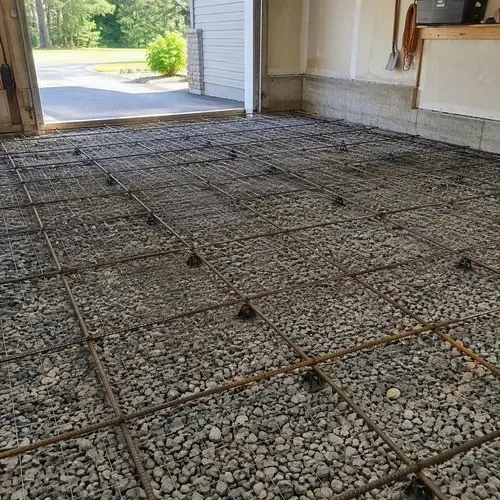
Compacted gravel base and wire mesh ready for a garage concrete floor pour

Slab on Grade, Overlay and Topping

This page covers placing new concrete. Grinding, polishing and coatings each have their own pages.

Full Slab Pours

A full slab is typically 3 to 4 inches thick for basements and 4 to 6 inches for garages and shops. It is placed over a compacted base with a vapour barrier.

For garage floors, the Ontario Building Code calls for concrete of at least 32 MPa with 5 to 8% air entrainment. That air helps it survive salt and freeze-thaw.
Self-Levelling Overlays on Existing Slabs

When a slab is sound but rough, uneven or pitted, a self-levelling cement overlay can give it a new surface. Overlays run from 1/8 inch to about 1-1/2 inches thick.

They are faster and cheaper than a new slab, and they are the usual base for polished overlays and coated floors. Uneven wood and concrete floors can also be corrected with floor levelling and patching.

Base Preparation, Compaction and Vapour Barrier

What goes under a slab decides how it behaves for the next 50 years. Most cracked and settled slabs we replace had a poor base.

We excavate to the right depth, place 4 to 6 inches of clear crushed stone and compact it in lifts with a plate tamper. Soft spots are dug out and replaced.

A 10 mil polyethylene vapour barrier goes on top with overlapped, taped seams, sealed at pipes and walls. For more on moisture control, see our floor vapour barrier installation service.

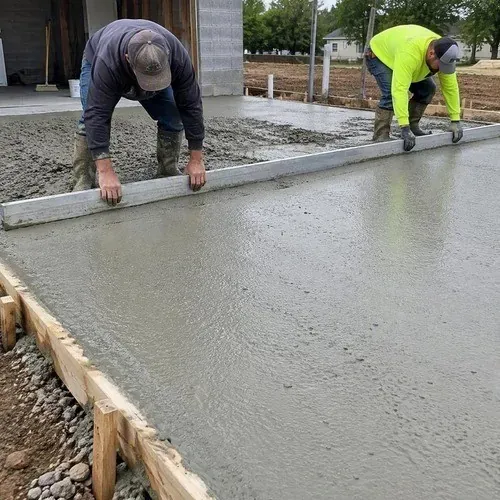
Wet concrete being screeded flat with a long straightedge

Reinforcement, Mesh and Fibre

Reinforcement does not stop concrete from cracking. It holds cracks tight so the slab stays together and level.

Welded wire mesh is common in garage and shop slabs, placed on chairs so it sits in the middle of the pour. Rebar goes into thickened edges and heavy load areas.

Synthetic macro fibres mixed into the concrete are an alternative or addition. They reduce shrinkage cracking throughout the slab.

Control Joints and Where Concrete Will Crack

All concrete shrinks as it cures. Control joints are planned weak lines that give that shrinkage a straight, tidy place to crack.

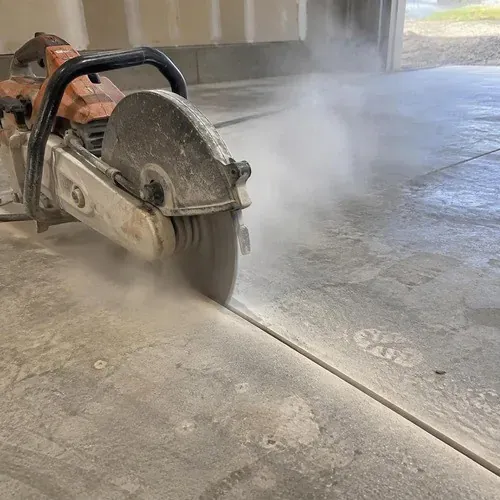
We saw cut joints to one quarter of the slab depth, usually within 6 to 18 hours of the pour. Spacing is 24 to 36 times the slab thickness, so a 4 inch slab gets joints every 8 to 12 feet.

Joints are laid out in square panels, and at re-entrant corners, where cracks are most likely to start.

Control joint being saw cut into a cured concrete floor

Flatness, Finishing and Power Trowelling

Concrete is struck off with a straightedge, floated and then finished. For large areas we use a ride-on or walk-behind power trowel.

The finish depends on what comes next. A hard steel trowel finish suits polishing. A lighter broom finish gives grip on exterior slabs, and coatings prefer a surface that will be ground anyway.

Flatness is checked with a straightedge. Floors that will receive tile, vinyl or wood are finished to the tolerance those materials need.

Curing Time in Ontario Conditions

Concrete gets stronger for weeks after it is poured, but only if it stays moist and warm. We cover new slabs with curing blankets or apply a curing compound.

In cold weather, the ground must not be frozen and the air above the slab needs to stay above 5 degrees Celsius. Garages and shops are heated and tented, and insulated blankets hold in the warmth.

Light foot traffic is fine after about 24 hours. Vehicles can use a garage slab after 7 days. Most coatings and flooring need 28 days and a passing moisture test.

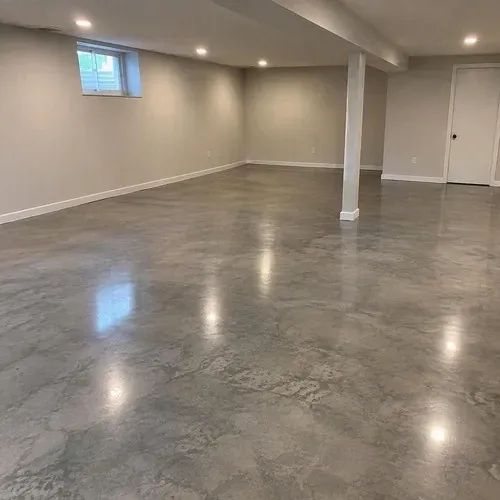
Finished concrete basement floor ready for polishing or coating

What Comes Next, Coating, Polishing or Covering

A new slab is a blank canvas. Here are the most common next steps.

  • Concrete polishing for a durable, glossy finish with no coating to wear off.
  • Epoxy flooring for garages, shops and commercial floors that need colour and chemical resistance.
  • Hardwood, vinyl or tile over a vapour barrier, in finished basements.

Concrete Floor Pricing

Typical 2026 ranges in Waterloo Region:

Item Typical cost per sq ft
New basement slab, including base and barrier $8.00 to $14.00
Garage or shop slab, 4 to 6 inch $8.00 to $13.00
Break out and remove existing slab $3.00 to $6.00
Self-levelling overlay $3.00 to $7.00

Access, pumping and winter heating are priced separately. All concrete work includes our 1-year labour warranty.

FAQ

Concrete Floor Questions

Straight answers to the questions we hear most. Still unsure? Call and ask.

Ask for a Free Quote

How long before a new concrete floor can be coated?

Most coatings need the slab to cure for at least 28 days, and then pass a moisture test. Some moisture-tolerant primers allow earlier coating. We test before we coat, never on the calendar alone.

Will a new concrete floor crack?

Almost every slab develops some small cracks as it shrinks. Control joints decide where those cracks form, so they run in straight, planned lines instead of randomly. Good base prep and curing keep cracking to a minimum.

Can concrete be poured in an Ontario winter?

Yes, with precautions. The ground must not be frozen, the space needs heat, and the slab is covered with insulated curing blankets. Interior basement slabs in heated homes are the easiest winter pours.

Do I need a vapour barrier under a basement slab?

Yes. The Ontario Building Code requires dampproofing under a basement floor slab, and polyethylene sheet is the usual method. We use a heavy 10 mil sheet with taped seams because it resists tearing during the pour.

Free estimate

Book a Free Concrete Floor Installation Estimate

Tell us about the floor. We will call to book a time, measure on site, check the subfloor and moisture, and leave you a written quote.

Prefer to talk it through first? Call and speak to a flooring specialist directly.

  • Measured on site, with moisture and flatness readings
  • Written, itemized quote with no obligation
  • Licensed, insured, WSIB covered, 1-year labour warranty

Kitchener Prestige Flooring

137 Glasgow St, Kitchener, ON N2M 5E3

info@kitchenerflooring.ca

Monday to Saturday: 7:00am to 9:30pm

Sunday: 9:00am to 9:00pm

Call (548) 490-1518 Quote