Etching From Acids
Citrus, wine, vinegar, soft drinks and many household cleaners leave dull, light marks on polished marble. They often look like water spots that will not wipe off.
Tile & stone
A dull, etched or scratched marble floor can almost always be brought back without replacing a single tile. Kitchener Prestige Flooring restores marble floors for homeowners, condo boards, churches and commercial buildings across Kitchener and Waterloo Region.
Our team brings more than 16 years of flooring experience and 1,700+ completed jobs. On marble, that means knowing the difference between an etch and a stain, and choosing the right diamond, powder or poultice for each.
We are licensed, insured and WSIB covered. Every restoration carries a written 1-year labour warranty, and we record gloss readings so you can see the result in numbers.
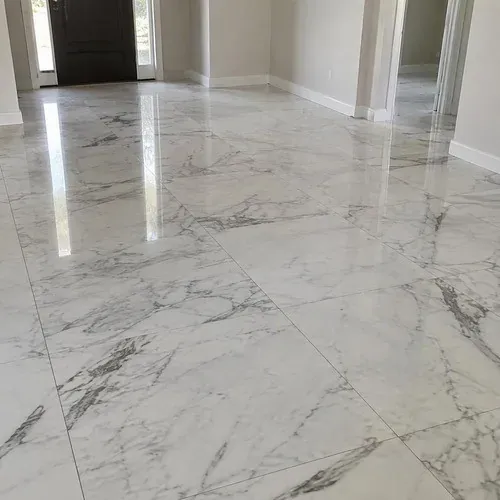
Marble is soft and reactive, so it wears in predictable ways. These are the four problems we are called about most.
Citrus, wine, vinegar, soft drinks and many household cleaners leave dull, light marks on polished marble. They often look like water spots that will not wipe off.
Sand and grit tracked in on shoes act like sandpaper. Over time, main walkways lose their shine and look hazy next to the edges of the room.
Oil, coffee, rust and dye can soak into marble and leave a darker or coloured mark. Water rings and dark patches can also appear where moisture sits under or in the stone.
Lippage is when one tile edge sits higher than the next. It catches dirt, chips at the edges and breaks up reflections across the floor.
This distinction decides the whole repair. It is where many restorations go wrong.
An etch is damage to the surface. The acid has eaten away the polish, so the mark is usually lighter and duller than the stone around it. It is fixed by honing and polishing.
A stain is something absorbed into the stone. It is usually darker or coloured, and polishing does nothing to it. It is fixed by drawing it out with a poultice.
We test each mark on site before deciding which it is.
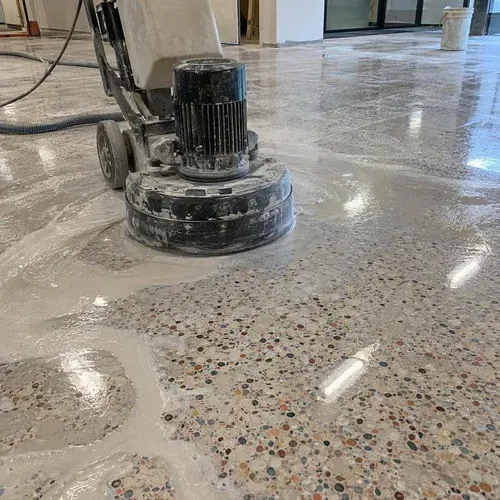
Restoration is a sequence, and skipping stages shows in the final finish.
Where tiles are uneven, we grind the whole floor flat with metal-bonded diamonds. This removes lippage and turns a tiled floor into one continuous surface.
Grinding is only done when needed, because it is the most aggressive and slowest stage.
Honing uses resin-bonded diamond pads, working from coarse to fine, typically through 100, 200, 400, 800 and 1500 grit. Each step removes the scratches left by the one before.
A honed finish can be the end point for kitchens and bathrooms, where a matte look hides future wear.
For a high shine, we finish with a marble polishing powder worked in with a natural hair pad under a slow-speed machine. The powder reacts with the surface to produce a deep, glassy polish.
The result is the reflective finish marble is known for, without any coating to wear off.
We measure gloss with a gloss meter before and after the work. It gives a number in gloss units, so the result is not just a matter of opinion.
A dull, trafficked marble floor often reads in the teens or twenties. A properly polished floor usually reaches 70 or more.
You receive the before and after readings. For commercial clients, those readings set a benchmark for future maintenance.
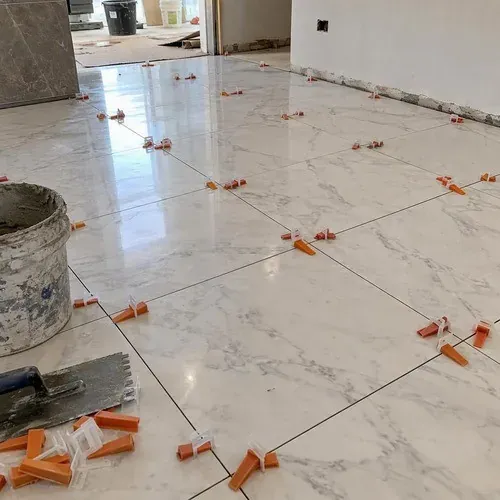
A poultice is a paste of absorbent powder mixed with a chemical matched to the stain. It is spread over the mark, covered and left for 24 to 48 hours.
As it dries, it pulls the stain out of the stone into the powder. Oil stains, organic stains like coffee, and rust each need a different chemical.
Stubborn stains may need two or three applications. We tell you honestly how much improvement to expect.
After restoration, we apply a penetrating impregnating sealer to slow down future staining. Sealing does not prevent etching, so gentle cleaning still matters.
We leave you care instructions: pH-neutral stone cleaner, doormats at every entrance and prompt cleanup of acidic spills. Resealing every one to two years is handled by our floor sealing and waterproofing service.
Older bank halls, churches, hotels and office lobbies across Kitchener, Cambridge and Guelph often have original marble. Decades of wax and wear hide beautiful stone.
We strip old coatings, repair damaged tiles and restore the floor in sections, often overnight so the building stays open. Heritage floors are treated with the gentlest method that works.
Grout lines in these floors often need attention too. See our tile and grout restoration page.
Typical 2026 ranges in Waterloo Region:
| Service | Typical cost |
|---|---|
| Hone and polish, no lippage | $4.00 to $10.00 per sq ft |
| Grind flat, hone and polish | $8.00 to $15.00 per sq ft |
| Poultice stain removal | $75 to $200 per stain |
| Penetrating seal after restoration | $1.00 to $2.00 per sq ft |
Small areas carry a minimum charge. All restoration work includes our 1-year labour warranty.
Planning new stone instead? See marble floor installation and natural stone flooring.
Keep exploring
Where this service is in highest demand:
FAQ
Straight answers to the questions we hear most. Still unsure? Call and ask.
Ask for a Free QuoteYes. Etch marks are surface damage, so honing and re-polishing removes them. Light etches come out with polishing powder alone, while deeper etching needs a few passes with diamond pads first.
A typical foyer or bathroom takes one to two days. Large areas or floors that need grinding flat for lippage take longer. Commercial lobbies are often done overnight in sections.
Many stains can be drawn out with a poultice, sometimes over two or three applications. Very old stains, rust from metal and dyes that have reacted with the stone may lighten but not disappear completely.
Homes usually need a full re-polish every three to five years, depending on traffic. Busy commercial lobbies do better with regular maintenance polishing every few months and a deeper restoration every year or two.
Free estimate
Tell us about the floor. We will call to book a time, measure on site, check the subfloor and moisture, and leave you a written quote.
Prefer to talk it through first? Call and speak to a flooring specialist directly.
Kitchener Prestige Flooring
137 Glasgow St, Kitchener, ON N2M 5E3
Monday to Saturday: 7:00am to 9:30pm
Sunday: 9:00am to 9:00pm