Skip to content
Kitchener Prestige Flooring

Protection & treatments

Soundproof Flooring Installation in Kitchener, Ontario

Footsteps, dropped toys and chair scrapes travel straight through a floor unless it is built to stop them. Kitchener Prestige Flooring installs acoustic underlays and soundproof floor assemblies for condo owners, landlords, homeowners and commercial tenants across Kitchener and Waterloo Region.

Our team has more than 16 years of experience and 1,700+ flooring jobs. We know that underlay alone rarely solves a noise complaint, and we explain what will and will not help before you spend money.

We are licensed, insured and WSIB covered. Every soundproof installation is backed by a written 1-year labour warranty and product data your condo board can review.

  • Licensed & insured
  • WSIB covered
  • 1-year labour warranty
  • Free in-home estimates
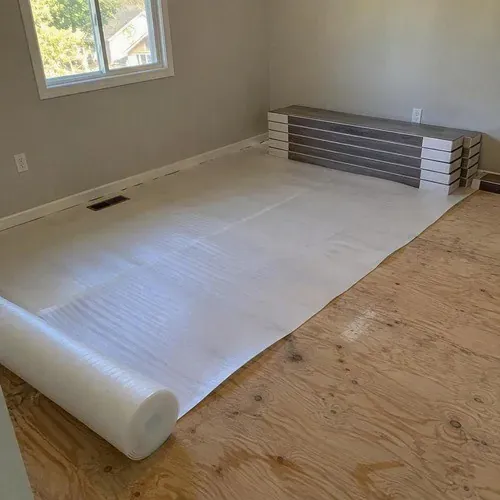
Acoustic underlayment rolled out before a soundproof floor installation

Impact Noise Versus Airborne Noise

Noise travels through floors in two ways, and each needs a different fix.

Impact noise is created when something strikes the floor: footsteps, dropped objects, chairs sliding. It travels through the structure itself.

Airborne noise is sound in the air, like voices, music and TV. It passes through gaps and thin materials.

Flooring underlays mainly reduce impact noise. Airborne noise is mostly controlled by the mass and sealing of the floor and ceiling assembly.

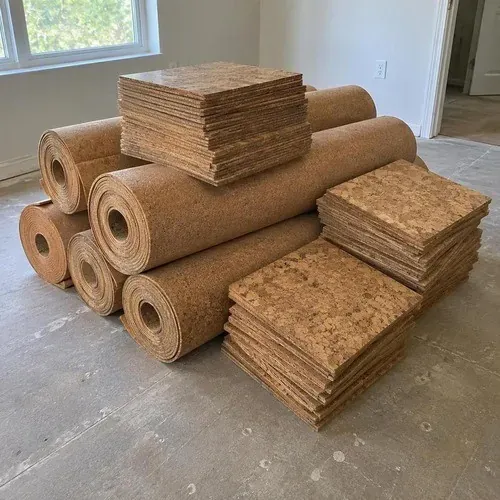
Rolls of cork acoustic underlayment staged for a condo floor

IIC and STC Ratings, and What Your Condo Board Wants

IIC, Impact Insulation Class, rates how well a floor-ceiling assembly blocks impact noise. Higher is better.

STC, Sound Transmission Class, rates airborne noise. The Ontario Building Code sets minimum airborne sound ratings between dwelling units, but it does not set an IIC requirement.

That is why most Waterloo Region condo corporations write their own rules. Many require an IIC of 50 to 60 or more for hard floors and ask to approve the underlay first. We provide the product test data for your board.

Acoustic Underlay Options

Underlays sit directly under the finished floor and absorb impact before it reaches the structure.

Rubber and Cork Underlays

Recycled rubber underlays are dense and very effective on impact noise. They suit tile, engineered wood and glue-down floors.

Cork underlays are lighter, natural and perform well under floating floors. See cork flooring installation if you want cork as the finished floor too.
Foam and Closed-Cell Products

Closed-cell foams such as IXPE are thin, moisture resistant and common under click vinyl and laminate. Some planks come with them attached.

Many meet condo requirements on concrete slabs. We check the published test results for your assembly.

Mass Loaded Vinyl Layers

Mass loaded vinyl is a thin, heavy membrane that adds mass to a floor. Mass helps block airborne sound.

It is used alongside impact underlays in higher-performance assemblies, such as music rooms and home theatres.

Floating Floor Assemblies and Decoupling

For the most demanding projects, the whole floor floats. A resilient isolation layer is laid down, then a new subfloor of plywood or cement board, then the finished floor.

The new floor never touches the structure directly, so impact energy is absorbed before it travels. It adds height and cost, but the improvement is significant.

We use this approach for gyms and studios over living spaces, covered further on our gym and fitness flooring page.

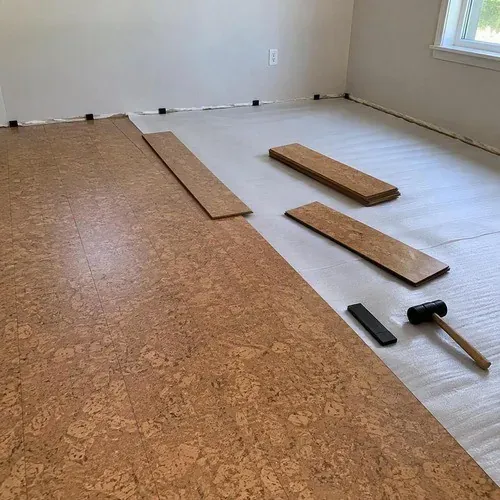
Floating floor planks assembled over an acoustic underlay

Perimeter Isolation, the Detail Everyone Skips

A great underlay can be undone at the walls. If the floor touches the wall, sound travels into the framing and around the underlay. This is called flanking.

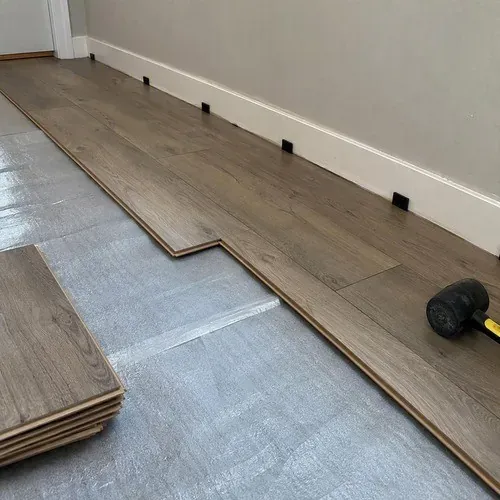
We install a perimeter isolation strip where the floor meets walls, cabinets and pipes. Baseboards are fastened to the wall only, with a small gap above the floor.

Gaps are finished with acoustic sealant rather than hard caulk. It takes more time and it is often where the rating is won or lost.

Soundproofing Over Concrete Versus Wood Joists

Condo slabs are heavy, which already helps with airborne noise. An acoustic underlay on concrete often brings impact ratings up to condo requirements.

Wood-joist floors in houses and townhomes are light and flexible. They transmit low-frequency thuds that underlays only partly fix.

On wood floors, the biggest gains often come from the ceiling below, with resilient channels and insulation. We will tell you if that is where your money is better spent.

Perimeter gap kept at the wall to isolate a floating floor acoustically

Which Floor Coverings Help and Which Make It Worse

  • Carpet with a good pad: the best impact noise performer.
  • Cork: naturally quiet and warm.
  • Vinyl plank with attached acoustic pad: a good option in condos.
  • Engineered wood and laminate: fine over the right underlay, noisy without it.
  • Tile and stone: the loudest, and they need a high-performance underlay.

Hard floors laid without any underlay are the source of most condo noise complaints. Luxury vinyl plank with an approved pad is often the practical middle ground.

Realistic Expectations, What You Can and Cannot Fix

A flooring underlay will reduce impact noise. It will not fix sound travelling through shared ductwork, plumbing chases, or gaps in walls.

It also cannot fix a structural path where framing runs continuously between units. Heavy low-frequency footsteps are the hardest noise to stop.

We give you honest expectations based on your building and assembly, and we never promise silence.

Soundproof Flooring Costs

Typical 2026 ranges in Waterloo Region:

Item Typical cost per sq ft
Acoustic foam or cork underlay, installed $0.75 to $2.00
Rubber acoustic underlay, installed $1.50 to $3.00
Floating isolated subfloor assembly $6.00 to $12.00
Perimeter isolation strip included in our installs

The finished floor is priced separately. All soundproofing work carries our 1-year labour warranty.

FAQ

Soundproofing Questions

Straight answers to the questions we hear most. Still unsure? Call and ask.

Ask for a Free Quote

What IIC rating does my condo require?

It depends on your building's declaration and rules. Many condo boards in Waterloo Region ask for a field or lab IIC of 50 to 60 or more for hard floors, and some require approval of the underlay before work starts. Ask your property manager for the exact requirement.

Will acoustic underlay stop footsteps being heard below?

It reduces them, sometimes a lot, but rarely eliminates them. Heavy footsteps are low-frequency sounds that travel through the structure. The whole assembly, including the ceiling below, decides the final result.

Is cork or rubber better for soundproofing?

Both work well. Rubber underlays usually perform better on impact noise at the same thickness and handle heavier loads.

Cork is lighter, natural and a good all-round choice. We choose based on the rating you need and the floor above.

Can I soundproof a floor without removing it?

Only a little. Rugs with thick pads help with impact noise. Real improvement means lifting the floor and installing an acoustic underlay or assembly, or improving the ceiling below.

Free estimate

Book a Free Soundproof Flooring Estimate

Tell us about the floor. We will call to book a time, measure on site, check the subfloor and moisture, and leave you a written quote.

Prefer to talk it through first? Call and speak to a flooring specialist directly.

  • Measured on site, with moisture and flatness readings
  • Written, itemized quote with no obligation
  • Licensed, insured, WSIB covered, 1-year labour warranty

Kitchener Prestige Flooring

137 Glasgow St, Kitchener, ON N2M 5E3

info@kitchenerflooring.ca

Monday to Saturday: 7:00am to 9:30pm

Sunday: 9:00am to 9:00pm

Call (548) 490-1518 Quote